Learn what an ecosystem is, how matter and energy move through it, and what makes it stable.
Most important points
- An ecosystem is composed of a community of organisms with their physical environment.
- Ecosystems can be of different sizes; can be marine, aquatic or terrestrial. The general categories of terrestrial ecosystems are known as biomes .
- In ecosystems, both matter and energy are conserved . Energy flows through the system, usually from light to heat, and matter is recycled.
- Ecosystems with greater diversity tend to be more stable, with greater resilience and resilience in the face of disturbances or damaging events.
Introduction
What do the tidal pools on the California coast and the Amazon rainforest in South America have in common? Despite the various orders of magnitude in size between them, they are both examples of ecosystems : communities of organisms living together in combination with their physical environment.
As a reminder, a community is made up of all populations of all species living together in a particular area. The concepts of ecosystem and community are closely related, the difference is that an ecosystem includes the physical environment, while the community does not. In other words, a community is the living, biotic component of an ecosystem. In addition to this biotic component, the ecosystem also includes an abiotic component : the physical environment.
Ecosystems can be small, such as tidal pools that are found near the rocky shores of many oceans, or very large, such as the Amazon rainforest in South America. Basically, its delimitation depends on the ecologist who studies it, who defines its size so that it makes sense to solve the questions of interest.
How are ecosystems?
The short answer: incredibly diverse! Not only can they vary in size, they also differ in any of the biotic and abiotic characteristics you can imagine.
Some types of ecosystems are marine, others freshwater and others, terrestrial. Oceanic ecosystems are the most common on Earth, as the oceans and living things that inhabit them cover 75% of the planet's surface. Freshwater ecosystems are the rarest, as they only cover 1.8% of the Earth's surface. Terrestrial ecosystems cover the remaining percentage.
Terrestrial ecosystems can be further grouped into broad categories based primarily on climate, known as biomes . Some examples of terrestrial biomes are jungles, savannas, deserts, coniferous forests, deciduous forests and tundra. The following map shows the general distribution of the biomes on Earth.
Even within a biome there can be a lot of diversity. For example, both the Sonoran Desert on the left and the interior of Boa Vista Island on the right are classified as deserts, but they have very different ecological communities. There are many more species of plants and animals living in the Sonora desert.
Energy and matter in ecosystems
Ecosystem ecologists are often interested in tracking the movement of energy and matter through ecosystems.
We will see in more detail the movement of energy and matter when we consider the trophic networks , nets of organisms that feed on each other, and the biogeochemical cycles , the paths taken by the chemical elements in their movement through the biosphere. The organisms that are in an ecosystem tend to have adaptations , beneficial characteristics that arise by natural selection, that help them to obtain the matter and the energy that they require in the context of a specific ecosystem.
But before we go into detail, let's take a look at the fundamental characteristics of energy and matter transportation across ecosystems. Both energy and matter are conserved , are not created or destroyed, only follow different routes through ecosystems.
- Matter is recycled: the same atoms are used again and again.
- Energy flows through the ecosystem, usually enters the form of light and comes out as heat.
The material is recycled
Matter is recycled through Earth's ecosystems, although it can pass from one ecosystem to another, as happens when nutrients are drawn into a river1. The same atoms are used again and again, forming different chemical compounds and being incorporated into the bodies of different organisms.
As an example, let's look at how the chemical nutrients move through a terrestrial ecosystem. A terrestrial plant takes carbon dioxide from the atmosphere and absorbs other nutrients, such as nitrogen and phosphorus, from the soil; with them they form the molecules that make up their cells. When an animal eats the plant, it uses its molecules to obtain energy and matter for its own cells, often rearranging atoms and molecules into new forms.
When plants and animals perform cellular respiration - they break down the molecules to use as fuel - carbon dioxide is released into the atmosphere. Similarly, when they excrete debris or die, their chemical compounds are used by bacteria and fungi as a source of energy and building material. These decomposers release simple molecules back to the ground and into the atmosphere, where they can be absorbed again in the next round of the cycle.
Thanks to this recycling, the atoms that make up your body right now have long and unique histories. They have probably been part of plants, animals, other people and even dinosaurs3!.
The flow of energy is unidirectional.
Unlike matter, energy can not be recycled into ecosystems. Instead, their flow through them is a one-way street, usually from light to heat.
Energy usually enters the ecosystem as sunlight and is captured chemically by photosynthesizers such as plants and algae. It then passes through the ecosystem, changing its shape as organisms metabolize, produce waste, eat each other, and eventually die and decompose.
Each time the energy changes form, part of it becomes heat. Heat continues to count as energy, and therefore, no part of it is destroyed, but living things generally can not use heat as a source of energy. In the end, the energy that entered the ecosystem as sunlight dissipates as heat and radiates back into space.
This unidirectional energy flow through ecosystems means that each ecosystem needs a constant supply of energy, usually in the form of sunlight, in order to function. Energy can pass between organisms, but it can not be recycled because part of it is lost as heat in each transfer.
Stability and dynamics of ecosystems
Ecosystems are dynamic systems and a static ecosystem would be a dead ecosystem, just as a static cell is a dead cell. As we mentioned earlier, energy flows constantly through ecosystems and chemical nutrients are continuously recycled. At an organizational level above, organisms are born and die, populations fluctuate in their numbers and weather patterns vary seasonally and in increasingly less predictable ways.
Balance and disturbance
The balance is the steady state of an ecosystem, in which its composition and identity remain generally constant despite variations in the physical conditions and the structure of the biological community. The equilibrium of ecosystems can be broken by disturbances , adverse events that affect their composition.
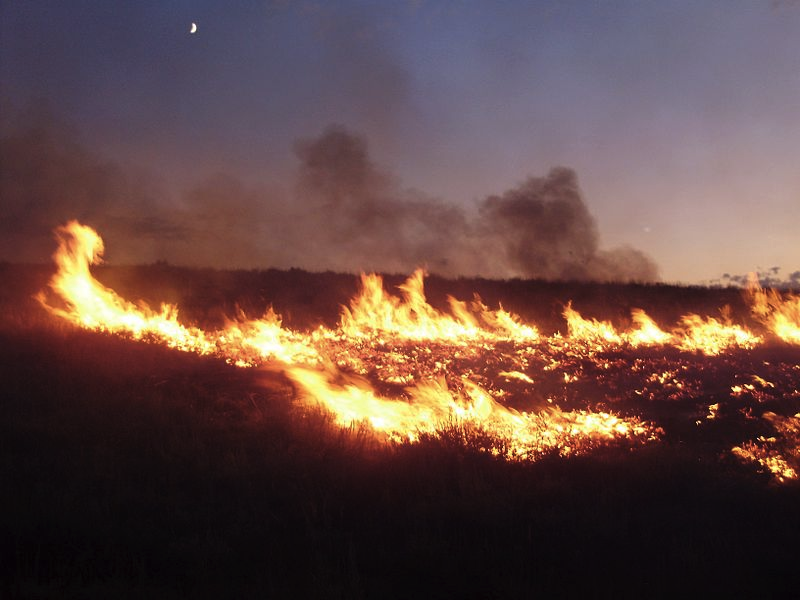

Some disturbances are the result of natural processes. For example, fires are a disturbance that can be caused by lightening in a prairie or forest ecosystem. Other disturbances are the result of human activity; some examples are acid rain, deforestation, algal blooms and the introduction of invasive species.
Different ecosystems respond differently to the same disturbance: some recover quickly, while others do so slowly or do not recover at all.
Resistance and resilience
Ecologists sometimes use two parameters to describe how an ecosystem responds to a disturbance: resilience and resilience . The ability of an ecosystem to remain in balance in spite of disturbances is called resistance . The rapidity with which the ecosystem regains its equilibrium after a disturbance is its resilience . Some ecologists consider that resistance is a component of resilience, one that acts on a short time scale.
Many ecologists think that the biodiversity of an ecosystem plays a key role in stability. For example, if there is only one species of plant with a particular function in an ecosystem, a disturbance that damages that species - say, a drought for a species sensitive to it - can have a strong impact on the ecosystem as a whole. On the other hand, if there are several plants with similar functions, there is a greater probability that some plants are resistant to drought and can help the whole ecosystem to survive the dry period6.
The resilience and resilience of an ecosystem are important when we consider the effects of disturbances caused by human activity. If a disturbance is severe enough, it can shift the ecosystem beyond the recovery point, pushing it to where it is no longer resilient. Such disturbance can lead to permanent disturbance or loss of the ecosystem.
Comments
Post a Comment